Showing posts with label WWF - Publications & Resources. Show all posts

Monday, November 21, 2016

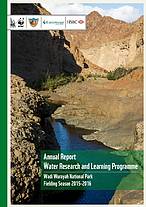
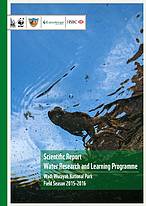
Scientific Report Water Research and Learning Programme Wadi Wurayah National Park Field Season 2015-2016

Scientific Report Water Research and Learning Programme Wadi Wurayah National Park Field Season 2015-2016 © Wouter Kingma / EWS-WWFStarted in 2013 in the Wadi Wurayah National Park (Fujairah Emirate – UAE), the Water Research Learning Programme (WRLP) has now completed its third season of field research activities.
 
This programme, funded by HSBC Bank Middle East Ltd. Under a 5-year agreement signed between EWS-WWF, Earthwatch and HSBC, aims to sensitise and educate volunteers on water conservation challenges relating to development and socioeconomic growth, as well as to involve those volunteers in field research activities. Teams of 10 to 12 volunteers from the whole MENA region are involved on a weekly basis from October to April, helping gather scientific data in the field and in the lab. The focus of the research is mainly the monitoring and understanding of the freshwater ecosystem of Wadi Wurayah, but other conservation topics related to the management of the national park are also getting attention.


Read Full Story from WWF - Publications & Resources http://wwf.panda.org/about_our_earth/all_publications/?uNewsID=285272
This Post was Published first on panda.org

Annual Report Water Research and Learning Programme Wadi Wurayah NationalPark Fielding Season 2015-2016

WRLP Annual Report 2015-2016 © Wouter Kingma / EWS-WWFThis annual report summarises the activities of Fielding Season 3 (October 2015 – April 2016) of the Water Research Learning Programme in the Wadi Wurayah National Park, Fujairah, United Arab Emirates.
 
The Water Research and Learning Programme (WRLP), implemented in the Wadi Wurayah National Park, is a 5-year programme designed by Earthwatch Institute UK and implemented by EWS-WWF. The programme is funded by HSBC Bank Middle East as part of its Global Water Programme. This programme is facilitated through the strategic partnership and support of Fujairah Municipality. The WRLP is hosted by the Water Research Centre (WRC), located at the entrance of Wadi Wurayah National Park in Fujairah, which offers comfortable and convenient facilities for participants during their 5-day module.
 
The WRLP's goal is to educate and raise awareness on freshwater issues and resources among residents and citizens of the Middle East region, as well as to encourage the wise use of water resources, provide practical ways for individuals to reduce their water footprints, conduct freshwater ecological research, and develop policies and regulations for the national park, based on relevant scientific knowledge.


Read Full Story from WWF - Publications & Resources http://wwf.panda.org/about_our_earth/all_publications/?uNewsID=285271
This Post was Published first on panda.org

Friday, November 18, 2016

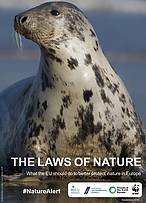
The Laws of Nature

The Laws of Nature are vital to protect our nature in Europe. © WWFThe Birds and Habitats Directives (here referred to as 'Nature Directives') are widely recognised as the cornerstone of EU-wide efforts to halt and reverse the loss of biodiversity. The nature conservation framework they establish underpins the effective protection of rare or threatened species within the EU across their natural range, and has led to the designation of NATURA 2000, the largest network of protected areas in the world, currently covering 18% of Europe's land and 6% of its seas.

hanks to the Nature Directives, threatened species such as the brown bear, the wolf, and the lynx are back from the brink of extinction. Although scientific evidence demonstrates the Nature Directives are effective when properly implemented, many Member States have not fully and effectively implemented their legal commitments under the Nature Directives. As a result, much of Europe's biodiversity is still in decline, and the EU risks missing its 2020 target of halting the loss of biodiversity and ecosystem services. Only 23% of animal and plant species and 16% of habitat types protected under the Habitats Directive have a favourable conservation status. A crucial step towards achieving the 2020 target is therefore for the EU to fully implement the Nature Directives.

However, this alone will not be enough, as policies that affect biodiversity in the wider landscape, such as those addressing agricultural practices and infrastructure development, also have an important role to play in addressing on-going biodiversity decline. Lack of targeted funding to secure ecological recovery remains also a major barrier.

The European Commission is currently carrying out a Fitness Check of the EU Nature Directives to evaluate whether the Directives are "fit for purpose" or should be changed. Many Member States, the European Parliament, progressive business, NGOs and more than half a million citizens have stood up for the Nature Directives, acknowledging that a revision of these Directives would create a long period of legal uncertainty and damage the fragile recovery of species and habitats in Europe, as well as jeopardise achieving the Biodiversity Strategy towards 2020.

The Directives must not be revised; instead the focus must be on full implementation, increased funding for nature conservation, and fully addressing the drivers of biodiversity loss in the wider countryside. 

Read how the Commission and Member States can effectively save Europe's nature now! 


Read Full Story from WWF - Publications & Resources http://wwf.panda.org/about_our_earth/all_publications/?uNewsID=285013
This Post was Published first on panda.org
Tuesday, November 15, 2016

Nepal - Water Risk Scenarios and Opportunities for Resilient Development

Nepal - Water Risk Scenarios and Opportunities for Resilient Development Volume 1 and 2 © WWF"Nepal - Water Risk Scenarios and Opportunities for Resilient Development" report is an attempt to pose, and answer, some of these key questions related to the future of Nepal's water resources – the natural capital that provides the foundation for all major economic activity. The exploration of these issues is done through scenario development, a useful tool to identify and interrogate plausible future developments that have implications for Nepal's river basins.


Read Full Story from WWF - Publications & Resources http://wwf.panda.org/about_our_earth/all_publications/?uNewsID=284652
This Post was Published first on panda.org

Tuesday, November 8, 2016

Lessons Learned and Recommendations from Early UNFCCC REDD+ Reference Levels Submissions

Lessons learned and recommendations from early UNFCCC REDD+ Reference Levels Submissions © WWF Forest & ClimateProduced in partnership with Environmental Defense Fund, International Union for the Conservation of Nature, The Nature Conservancy, and Union of Concerned Scientists, this paper presents lessons learned and best practice recommendations from an unprecedented workshop convening of two groups of experts: 
  1. those from REDD+ countries who were involved in creating FRLs/FRELs, and 
  2. those who had served as members of the Technical Team of Experts performing technical analysis of REDD+ results.

Forest Reference Levels/Forest Reference Emissions Levels (FRLs/FRELs) are critical to the policy framework for Reducing Emissions from Deforestation and forest Degradation (REDD+), and provide the benchmark against which countries measure their results from REDD+ implementation. FRLs/FRELs are still incipient, and REDD+ countries and technical assessors are still in a learning-by-doing process, generating valuable lessons that are worth sharing.

Read and download the full report via the link to the right.


Read Full Story from WWF - Publications & Resources http://wwf.panda.org/about_our_earth/all_publications/?uNewsID=283374
This Post was Published first on panda.org

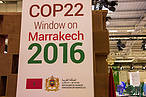
Fulfilling the promise of Paris in Marrakech: WWF asks for COP22

COP22 will be held in Marrakech, Morroco © ClimateAllianceThe Paris Agreement is a political milestone with the potential to refocus global efforts around one of the most challenging problems humanity faces. That the Agreement enters into force on 4 November, much earlier than anyone imagined in last December, along with recent progress at the International Civil Aviation Organization (ICAO) and the Montreal Protocol are encouraging signs of continued political will to address climate change. Marrakech can now start with a muchdeserved celebration, and this positive spirit and momentum should motivate Parties to make substantive progress in the first Post-Paris COP.

Yet much remains to be done for the Paris Agreement to fully galvanise global climate action and unleash the socio-economic and energy transformation necessary to deliver on the sustainable development goals while limiting warming to 1.5°C. Current country pledges bend the emissions curve, but still leave the world on course for around 3°C of warming – which will undermine our collective development aspirations and be catastrophic for many.

History will judge the Paris Agreement by whether governments, corporations, cities and other actors deliver the transformational policies needed to limit warming to 1.5°C. Marrakech is an opportunity to usher in a new way of doing business – it can build on the lessons of what has worked in the run up to Paris and create enabling conditions for greater collaboration, accelerated action and increased ambition.

Read WWF's asks for COP 22


Read Full Story from WWF - Publications & Resources http://wwf.panda.org/about_our_earth/all_publications/?uNewsID=283870
This Post was Published first on panda.org

Latest Posts