Showing posts with label News | Bank Information Center. Show all posts

Tuesday, April 26, 2016

The Predicament of Accessing Translated Information at the World Bank

This post is from Bank Information Center - Amplifying Local Voices to Democratize Development.

On December 5, 2015, a group of Civil Society Organizations (CSOs) from different countries across the Middle East and North Africa (MENA) submitted joint complaint letter to World Bank Group officials (WBG or Bank) regarding the Bank’s MENA regional program implementation of its translation framework. Having the signing support of twenty-five CSOs from Yemen, Iraq, Egypt, and Tunisia, Dr. Yahiya Saleh, head of the Sanaa-based Yemeni Observatory for Human Rights (YOHR), explained in his letter that accessibility to and availability of information is key to effective participation of stakeholders, especially in countries where access to certain information is challenging.

But despite the Bank’s disclosure policy , and its efforts to provide greater accessibility and transparency, translation remains, Saleh added, either limited in scope or difficult to locate.

The letter specifically stated:

“6 years after this commitment was made [in 2009 following a complaint made by Dr. Saleh] letter sent in, we would like revisit this issue because unfortunately, the effort and resources that are spent to provide these documents in the Arabic language have not come to fruition for a very simple reason.  Access to these documents through the Bank’s website requires first passing through two lists: a list of projects, and a list of documents available for each project, both of which are only available in English. This represents a serious obstacle for any citizen who is not fluent in English and who would like to access the Arabic documents provided by the Bank. We would like to invite you to use the external World Bank website to check these difficulties – among other shortcomings in accessibility – yourselves.”

While English is the official language of the Bank, the decision by the Bank’s Board of Executive Directors in 2003 to approve the translation framework was seen as departure from previous practices, aiming to encourage wider participation of stakeholders, clients, and communities. Furthermore in 2009, as a result of a complaint filed by YOHR, the MENA regional program at the Bank committed itself to translate into Arabic and post specific types of documents for all its involvement in the region. But to date, accessing these translated materials is not without a challenge, for they are hidden behind a list that is only available in English.

World Bank officials, on their part, recognize the challenge of information inaccessibility, vowing to make needed improvements. In a February 9, 2016 email response by the Office of Executive Director for Middle East and North Africa, Dr. Saleh was thanked for shedding the most light on the issue of information accessibility and was assured that efforts to translate into Arabic all major documents and projects will be augmented. In another email response dated February 18, 2016 by the Bank’s Vice President for Middle East and North Africa, he acknowledged the issue attributing it to a technical problem with the “automated utility that draws projects names and abstracts onto the website,” vowing to ensure greater accessibility and transparency. Furthermore, starting February 2016, according to the Vice President, the Bank launched an internal Policy and Procedural Framework to make certain that major documents and projects are translated into Arabic.

If not addressed, the scarcity of information and the difficulty associated with accessing what is available in Arabic will continue to pose real challenge to effective CSOs engagement and participation.

The World Bank Policy on Access to Information, launched in 2010, which promised to make information publically available, should also include the principle that information must be made accessible, chiefly through translations into relevant languages of the  stakeholders, and that should cover as much documents and project lists as possible. Access to information is not a privilege; it is a universal right, as outlined in the United Nations Universal Declaration of Human Rights.

The post The Predicament of Accessing Translated Information at the World Bank appeared first on Bank Information Center.


Read Full Story from News | Bank Information Center http://www.bankinformationcenter.org/the-predicament-of-accessing-translated-information-at-the-world-bank/
This article by Yasir Kuoti originally appeared on bicusa.org on April 26, 2016 at 07:50PM

Friday, April 22, 2016

Spring Meeting Panel on Access to Information

This post is from Bank Information Center - Amplifying Local Voices to Democratize Development.

Without accessible and comprehensible information, stakeholders cannot meaningfully engage in development. Bank Information Center, Fundar-Center of Analysis and Research, Yemeni Observatory for Human Rights, and Egyptian Association for Collective Rights organized a session during the the World Bank Spring Meetings Civil Society Policy Forum titled “Breaking Down Barriers to Accessing Development Information”.

The panelists presented case studies and anecdotal evidence from Egypt, Mexico and Yemen to depict the challenges faced by civil society and affected communities when accessing information on development programs and project financed by the World Bank Group.

Jpeg

Jpeg

The following list of recommendations to ensure that stakeholders can more easily access such information was discussed in this session:

  1. Identify Bank officials that can hold regional departments accountable for providing their constituencies accessible and comprehensible information.
  2. Attend to language barriers that are “easy fixes” on the Bank’s website and portals. The following are two examples of such barriers were mentioned: i) the instructions to create an account to submit an information request on the Bank’s online request portal are only in English, ii) regional programs, such as the Middle East North Africa Program, routinely posts documents in Arabic that are hidden behind a menu in English. Such barriers are hindering affected constituencies from accessing information readily available in their native languages.
  3. The Bank has a plethora of highly useful information readily available on its website. Therefore, it should share this with communities and CSOs by conducting in-country trainings on how to access to information on its website.
  4. Implement a policy on disseminating a flier in communities affected by its’ development projects in the local language. This flier should have information that discloses to communities that the Bank is funding a project in their area,  their basic rights according to the Safeguards and links for more information.

The post Spring Meeting Panel on Access to Information appeared first on Bank Information Center.


Read Full Story from News | Bank Information Center http://www.bankinformationcenter.org/14098/
This article by Muna Rehman originally appeared on bicusa.org on April 22, 2016 at 11:41PM

Open for Business Award for ED Website Transparency goes to EDS05 Germany

IMG_1749

This post is from Bank Information Center - Amplifying Local Voices to Democratize Development.

At the 2016 World Bank Spring Meetings, the Office of the Executive Director – EDS 05 won the “Open for Business” award for the most transparent website among the 25 World Bank Executive Directors’ offices. Ursula Müller, Executive Director from the Germany, received the award during the CSO Roundtable with World Bank Executive Directors on Tuesday, April 12th, 2016.

CIVICUS and BIC co-hosted the awards. As Alex Sardar (CIVICUS) presented Ms. Müller with the award, he emphasized the importance of transparency in facilitating cooperation between members of civil society and the World Bank. Click here for the full Open for Business Award Spring 2016 scorecard and rankings.

On March 2013, CIVICUS: World Alliance for Citizen Participation and its partners suggested that the World Bank Executive Directors deepen their engagement with civil society by increasing transparency on their official websites. This includes announcing official travel schedules for ease of arranging in-country meetings with constituents, listing names and contact information of key staff members and their areas of responsibilities, and publishing official positions on policies and projects brought to the Board of Directors.

CIVICUS and the Bank Information Center have since developed a scorecard measuring ED offices’ progress in increasing their transparency. The “Open for Business” award is given out during World Bank’s Annual and Spring Meetings in recognition of the most transparent ED offices. The last award, given during the 2015 Annual Meetings in Lima, Peru, went to EDS 01 representing the United States.

The post Open for Business Award for ED Website Transparency goes to EDS05 Germany appeared first on Bank Information Center.


Read Full Story from News | Bank Information Center http://www.bankinformationcenter.org/open-for-business-award-for-ed-website-transparency-goes-to-ms-mueller/
This article by Natalia Margolis originally appeared on bicusa.org on April 22, 2016 at 06:48PM

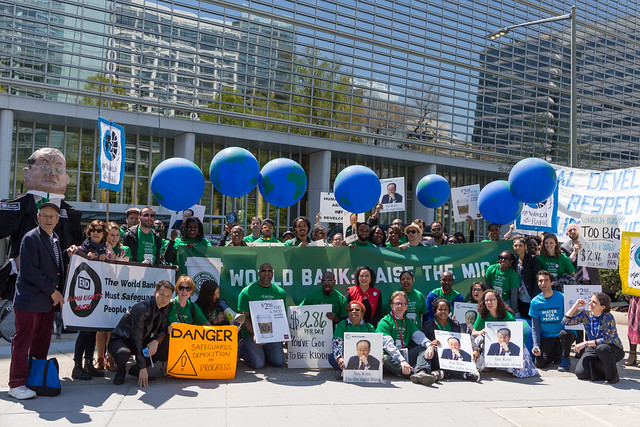
DC World Bank Protest: Protections for People Not for Profit!

world-bank-protest-washington-dc---april-15-2016_25904049563_o

This post is from Bank Information Center - Amplifying Local Voices to Democratize Development.

On Friday, April 15th the Coalition for Human Rights in Development (global coalition of social movements, civil society organizations, and grassroots groups working to ensure that all development finance institutions respect human rights) held a protest outside the World Bank headquarters. Activists highlighted the World Bank’s failure to produce a strong, mandatory set of safeguard policies protecting people and the planet from the negative impacts of development projects.

Throughout the history of the World Bank, projects like dams, roads, power plants have inflicted harm on some local communities and ecosystems, including through project side effects like eviction, pollution, and human rights abuses. Examples of these calamities was thrown into sharp light last year by the ICIJ’s series of reports entitled Evicted and Abandoned: The World Bank’s Broken Promise to the Poor.

Over the past three years, the Bank has struggled to revise their safeguard policies to prevent similar disasters in the future. Unfortunately, there remains controversy over issues such as the inclusion of protections for vulnerable groups like children, persons with disabilities, and members of LGBTQ communities. Advocates are demanding that the World Bank ensure that these groups, their livelihoods, and their environments are protected from the potentially harmful side effects of development.

The protest was held during the World Bank and IMF Spring Meetings in Washington, DC, in partnership with the Raise the MIC campaign, who are urging the World Bank to reconsider the way it classifies middle-income countries (MICs). MICs receive less foreign aid and pay higher prices for essential medicines and medical commodities.

For more information on the World Bank safeguards review process, visit BIC’s Safeguards page.

World Bank Protest, Washington DC - April 15, 2016

The post DC World Bank Protest: Protections for People, Not for Profit! appeared first on Bank Information Center.


Read Full Story from News | Bank Information Center http://www.bankinformationcenter.org/dc-world-bank-protest-protections-for-people-not-for-profit/
This article by Julia Radomski originally appeared on bicusa.org on April 22, 2016 at 05:17PM

Thursday, April 21, 2016

Lebanese Figure Calls for the Integration of Human Rights into World Bank Programs

Photo Source: Rightsobserver.org

This post is from Bank Information Center - Amplifying Local Voices to Democratize Development.

Image Source: Rightsobserver.org

As the World Bank Group (WBG or the Bank) is currently reviewing its safeguards policies, several Civil Society Organizations (CSOs) began calling for the integration of human rights principles in the new policies, seeing human rights as an important aspect of development policies and countries programing.

But integrating human rights principles (HRPs) into the Bank’s programs is not always struggle-free. The challenge is particularly striking in non-western countries, some of which perceive, ardently, the Bank’s human rights agenda as a western alibi for political changes and infringement on sovereignty.

Not in Lebanon. In his recent letter to the Bank’s President and Board of Executive Directors, Dory Chamoun, the son of former Lebanese President Kamil Chamoun, who is currently the president of the National Liberal Party and member of Lebanese parliament, avidly urged the Bank to include human rights in its policies and operations. In the letter, Chamoun reminded the Bank of the important role Lebanon has played in drafting the Universal Declaration for Human Rights (UDHR), a role, he said, that Lebanon will never shy away from.

Human rights are the basics for development to be just, effective, and sustainable. The Bank should adopt human rights safeguards in all of its investment dealings.

The post Lebanese Figure Calls for the Integration of Human Rights into World Bank Programs appeared first on Bank Information Center.


Read Full Story from News | Bank Information Center http://www.bankinformationcenter.org/lebanese-figure-calls-for-the-integration-of-human-rights-into-world-bank-programs/
This article by Yasir Kuoti originally appeared on bicusa.org on April 21, 2016 at 05:44PM

Wednesday, April 20, 2016

Forests at the World Bank Group in a Post-Paris Agreement World

This post is from Bank Information Center - Amplifying Local Voices to Democratize Development.

Conservation International & BIC hosted a panel event at the Civil Society Policy Forum of the World Bank 2016 Spring Meetings on the Bank’s role in supporting forest commitments coming out of COP21. The panel includes Bank staff working on forests and climate change; CSO partners from FPP, WRI, CI, and Honduran indigenous organization MASTA; and a Norwegian government representative from NICFI.

The post Forests at the World Bank Group in a Post-Paris Agreement World appeared first on Bank Information Center.


Read Full Story from News | Bank Information Center http://www.bankinformationcenter.org/forests-at-the-world-bank-group-in-a-post-paris-agreement-world/
This article by Julia Radomski originally appeared on bicusa.org on April 20, 2016 at 11:00PM

Video: What Does Shrinking Space for Civil Society Mean for the Twin Goals?

This post is from Bank Information Center - Amplifying Local Voices to Democratize Development.

The World Bank has committed to 100% beneficiary feedback in its projects and aims through its corporate strategy to empower citizens to participate in the development process. At the same time, since 2012 over 60 countries have passed legislation restricting civil society’s ability to freely operate and many communities face intimidation or criminalization when raising concerns around development activities. This session drawa on examples of restrictions on citizen voice from Egypt, Azerbaijan, and Kenya; discuss implications of restricted civil society space for the World Bank’s development goals; and raise recommendations for ways in which the Bank can ensure participatory development.

The post Video: What Does Shrinking Space for Civil Society Mean for the Twin Goals? appeared first on Bank Information Center.


Read Full Story from News | Bank Information Center http://www.bankinformationcenter.org/video-what-does-shrinking-space-for-civil-society-mean-for-the-twin-goals/
This article by Julia Radomski originally appeared on bicusa.org on April 20, 2016 at 10:57PM

Tuesday, April 19, 2016

Video: Uganda Transport Sector Development Project Impacts on the Bigodi Community

This post is from Bank Information Center - Amplifying Local Voices to Democratize Development.

Members of the Bigodi community in Uganda tell the story of what happened in their village as a result of the construction of a road. The road was part of the World Bank-funded Uganda Transport Sector Development Project, which was canceled in December 2015. They discuss the negative social impacts of the project on their community, which included child labor, sexual harassment, and sexual abuse of children. This video was shown at the World Bank Spring Meetings 2016 in Washington, DC as part of a panel event Social Impacts of an Influx of Workers in Infrastructure Investments.

To learn more about Joy for Children Uganda, please visit: www.joyforchildren.org

To learn more about the Uganda Transport Sector Development Project, please visit BIC’s project page.

The post Video: Uganda Transport Sector Development Project Impacts on the Bigodi Community appeared first on Bank Information Center.


Read Full Story from News | Bank Information Center http://www.bankinformationcenter.org/video-uganda-transport-sector-development-project-impacts-on-the-bigodi-community/
This article by Julia Radomski originally appeared on bicusa.org on April 19, 2016 at 09:23PM

Press Release: LGBTQ Activists Meet With World Bank President Dr. Jim Kim at Spring Meetings

Kim-Selfie-SOGIE

This post is from Bank Information Center - Amplifying Local Voices to Democratize Development.

International activists discussed research gaps, safeguards, and new advisory position at the World Bank

On April 11th, World Bank President Jim Yong Kim met with activists from 17 countries to discuss how LGBTI individuals can fully benefit from World Bank projects and programs in light of the powerful discrimination they experience in their countries. The activists were in town for the World Bank and International Monetary Fund’s Spring Meetings. Accompanied by World Bank Executive Directors from Finland, Switzerland, Netherlands and Chile, as well as the Bank’s Chief Economist and a cameo appearance from U2’s Bono, the President reported on the long standing requests he has received on Bank activities related to SOGI (sexual orientation and gender identity).

At the meeting, Dr. Kim announced that the Bank would hire its first ever SOGI Advisor, a senior position to coordinate Bank work on SOGI and to facilitate the relationship with the SOGI community worldwide. He also announced that the Bank would fund 3 studies analyzing the cost of homophobia in Brazil, Chile, and Venezuela. The total cost of the studies is predicted to be $750,000. Dr. Kim committed to partnering with UNDP to prepare a funding proposal for a July meeting of SOGI donors in Uruguay, and to “working as hard as we can” to meet with members of the SOGI community when it travels. It was noted that the President will next visit India, Bangladesh and Sri Lanka.

Finally, the President noted the difficulty in passing a safeguard policy on SOGI at the Bank, due to strong opposition from countries including Saudi Arabia, Russia and Kuwait, but committed to vigorously supporting a nondiscrimination clause in the updated safeguards—set to be finalized this year—that would specifically identify the SOGI community.

The activists in the meeting expressed appreciation for Dr. Kim and the Executive Directors’ work but noted that there is a long way to go until LGBTI individuals can fully benefit from World Bank loans.

CONTACT:
Julia Radomski, Information Services Coordinator, Bank Information Center
jradomski@bankinformationcenter.org, 202-624-0636

The post Press Release: LGBTQ Activists Meet With World Bank President Dr. Jim Kim at Spring Meetings appeared first on Bank Information Center.


Read Full Story from News | Bank Information Center http://www.bankinformationcenter.org/lgbtq-activists-meet-with-world-bank-president-dr-jim-kim-at-spring-meetings/
This article by Julia Radomski originally appeared on bicusa.org on April 19, 2016 at 09:01PM

Tuesday, April 12, 2016

What to look forward to at the World Bank 2016 Spring Meetings

17139272185_111d8b54e1_z

This post is from Bank Information Center - Amplifying Local Voices to Democratize Development.

This week, BIC is working with civil society partners from around the world to discuss the most pressing social and environmental issues in development finance. These panel events and roundtable discussions are taking place during the World Bank Spring Meetings Civil Society Policy Forum. If you’re in DC for the Spring Meetings, join us in exploring the following issues:

Forests at the World Bank Group in a Post-Paris Agreement World
Tuesday, April 12, 4:00-5:30 pm
Conservation International & BIC are hosting a policy forum event on the Bank’s role in supporting forest commitments coming out of COP21. We’ll have a panel including: Bank staff working on forests and climate change; CSO partners from FPP, WRI, CI, and Honduran indigenous organization MASTA; and a Norwegian government representative from NICFI.

IFI Development Policy Operations: How Environmental and Social Standards Apply
Wednesday, April 13, 11:00-12:30 pm
World Bank I Building

Join Greenpeace Indonesia, urgewald, KR Foundation, and BIC for a conversation on environmental and social risk management in development policy finance. National reforms implemented under policy loans from international finance institutions can drive development trends for many years after they are disbursed. Hear representatives from the World Bank Board, Operations Policy and Country Services, the Independent Evaluation Group and civil society weigh in on the 2015 Development Policy Financing Retrospective, and participate in a discussion around possibilities for achieving the highest environmental and social standards in policy-based development lending.

Breaking Down Barriers to Accessing Development Information
Wednesday, April 13 2:00-3:30 pm
World Bank I Building, Room I2-250

Without accessible, understandable information, stakeholders cannot meaningfully engage in development. This session, hosted by fundar, Yemeni Observatory for Human Rights, and BIC, will look at the reality of civil society and affected communities’ access to information about World Bank Group-financed development programs though examples from Egypt, Mexico, and Yemen, and will discuss recommendations and steps that can be taken to ensure that stakeholders can more easily access this key information.

Social Impact of an Influx of Workers in Infrastructure Investments
Thursday, April 14 2:00-3:30 pm
World Bank I Building, Room I2-210
Gender Action, Joy for Children Uganda, BIC

Many large scale infrastructure projects, along with projects in the extractives sector, can bring a large influx of workers into communities that had previously had little experience with migrant workers. There are often significant negative impacts of such an influx, such as increased sexual exploitation of women and girls or pressure for adolescents to leave school and earn money selling goods to such workers. This panel will explore the impacts of an influx of workers into communities using real world examples, including the recently canceled Kamwenge-Kabarole roadway in the hope of understanding what can be done to prevent or mitigate these negative impacts while maximizing positive impacts.

What Does Shrinking Space for Civil Society Mean for the Twin Goals?
Thursday, April 14 4:00-5:30 pm
World Bank I building, Room I2-220
Human Rights Watch, Oxfam, World Movement for Democracy, International Accountability Project, Coalition for Human Rights in Development, BIC

The World Bank has committed to 100% beneficiary feedback in its projects and aims through its corporate strategy to empower citizens to participate in the development process. At the same time, since 2012 over 60 countries have passed legislation restricting civil society’s ability to freely operate and many communities face intimidation or criminalization when raising concerns around development activities. This session will draw on examples of restrictions on citizen voice from Egypt, Azerbaijan, and Kenya; discuss implications of restricted civil society space for the World Bank’s development goals; and raise recommendations for ways in which the Bank can ensure participatory development.

The post What to look forward to at the World Bank 2016 Spring Meetings appeared first on Bank Information Center.


Read Full Story from News | Bank Information Center http://www.bankinformationcenter.org/events-to-look-forward-to-during-the-world-bank-2016-spring-meetings/
This article by Julia Radomski originally appeared on bicusa.org on April 12, 2016 at 06:03PM

Monday, April 11, 2016

BIC publishes guidebook on IMF policy advice in Myanmar

People cross the street near the Sule Pagoda and City Hall in central Yangon, Myanmar.

This post is from Bank Information Center - Amplifying Local Voices to Democratize Development.

Understanding the role of the International Monetary Fund (IMF) in shaping the economic policies of developing countries can be a challenge, especially in a country like Myanmar where the political and economic fabric of the country is rapidly changing. Together with New Rules for Global Finance, an organization that advocates for reforms in the rules and institutions governing the global financial system, BIC has developed a guidebook in order to demystify the Fund’s activities in Myanmar.

This guidebook, entitled Understanding & Influencing IMF Policy Advice in Myanmar, provides essential information about the IMF to civil society groups and other interested stakeholders so that they can actively and effectively shape the institution’s involvement in their country. The guidebook is organized into four parts, each of which can be used as standalone elements for events such as training sessions or workshops.

Part I provides an overview of the content in this guidebook. This section can also be used as a primer for civil society organizations who may not be familiar with the technical language used by the IMF or who just want a brief introduction to the topic.

Parts II and III form the heart of this guidebook. These sections include a summary of the IMF and its core functions; a review of the IMF’s activities in Myanmar and how these activities can impact key policy areas; and advice for civil society on how to engage with staff at the International Monetary Fund and influence the policy discussions between the IMF and your government.

Readers can use the appendices in Part IV to learn more about the IMF’s history, structure, and voting membership. This section also includes a short introduction to macroeconomics as well as contacts for key staff within the IMF and the civil society organizations that monitor the IMF’s activities.

 Download the Guidebook below:

Understanding and Influencing IMF Policy Advice in Myanmar (full guidebook), New Rules and Bank Information Center, April 2016

Introduction to Myanmar and the IMF (excerpt), New Rules and Bank Information Center, April 2016

CSO Engagement with the IMF (excerpt), New Rules and Bank Information Center, April 2016

If you think Civil Society in your country would benefit from a guidebook like the one presented above, please feel free to contact Nathan Coplin at ncoplin@new-rules.org and/or Sarah McNeal at smcneal@bankinformationcenter.org.

The post BIC publishes guidebook on IMF policy advice in Myanmar appeared first on Bank Information Center.


Read Full Story from News | Bank Information Center http://www.bankinformationcenter.org/bic-publishes-guidebook-on-imf-policy-advice-in-myanmar/
This article by smcneal originally appeared on bicusa.org on April 11, 2016 at 11:40PM

Wednesday, March 30, 2016

Iraqi CSOs Attend a Consultation Session on the World Bank’s Safety Guards

This post is from Bank Information Center - Amplifying Local Voices to Democratize Development.

Iraqi Civil Society Organizations (CSOs) are actively trying to hold their central and provincial institutions accountable. Like their local counterparts who continue to plan public protests against government corruption, some local CSOs are focusing more of their civic efforts on the development work of the World Bank (WBG or Bank) in Iraq.

Six local CSOs from different regions of Iraq have recently partnered together to form Tahalif al-Raay or the Opinion Coalition. These include the Sons of the Displaced Organization, al-Noor Universal Foundation, Organization for Child and Women Affairs, al-Inbithaq for Development and Economic Development, and Freedom Press Advocacy Association in Iraq.

While their areas of civic interests and expertise might differ, ranging from women and child rights to displaced population to development, these CSOs have the common goal of working with the Bank to hold the Iraqi government accountable on Bank-funded projects in the country.

Recently in February 2016, the Bank invited the Coalition to attend a consultation session in Beirut, Lebanon on the Bank’s safeguards. The session, attended by representatives from the Iraqi government, Kurdish Regional Government as well as local CSOs, was designed to seek inputs from the participants to inform the development of the Bank’s review of its safeguard policies.

Following the session, CSOs representatives submitted their asks to Bank officials in Baghdad, detailing a strategy to alleviate poverty in the country. Among the asks was that the Bank must make it binding for the Iraqi government to set the stage for cultural, social, and economic accommodation of the poor, create employment opportunities, build local capacity, and social safety nets. CSOs also offered advice on developing a community monitoring of government performance in its implementations of projects. This is especially important in a country where Bank’s staff cannot travel freely and that is ranked 161 out of 168 in the last Corruption Perception Index of 2015. According to the World Bank, “endemic corruption [in Iraq] is one of the main factors contributing to state weakness…corruption is widespread, transparency and accountability are weak, and the rule of law is poorly applied. Citizen engagement in oversight is weak. These weaknesses affect the delivery of public services; access is uneven for individuals and businesses as in the playing field for private sector provision” (World Bank-Iraq Country Partnership Strategy FY 13-16).

Now that the Bank is becoming more directly involved in devising Iraq’s federal budget, and is providing more loans and grants to fund projects and deal with budget deficit, CSOs feedback becomes particularly consequential.


The post Iraqi CSOs Attend a Consultation Session on the World Bank’s Safety Guards appeared first on Bank Information Center.


Read Full Story from News | Bank Information Center http://www.bankinformationcenter.org/iraq-csos-attend-a-consultation-session-on-the-world-banks-safety-guards/
This article by Yasir Kuoti originally appeared on bicusa.org on March 30, 2016 at 05:45PM

Tuesday, March 29, 2016

District Court Rules World Bank Can’t be Sued

tata

This post is from Bank Information Center - Amplifying Local Voices to Democratize Development.

Press statement from Earth Rights International: Plaintiffs plan to appeal decision that IFC has “absolute immunity”

A federal district court in Washington, D.C., ruled last week that the International Finance Corporation (IFC), the private lending arm of the World Bank Group, has absolute immunity and thus cannot be sued in the United States.

Fishing communities and farmers represented by EarthRights International (ERI) filed suit against the IFC last year over the destruction of their livelihoods and property and threats to their health caused by the IFC-funded Tata Mundra coal-fired power plant in Gujarat, India. The IFC moved to dismiss the case, arguing that it is not subject to the authority of U.S. courts, no matter how harmful or illegal its actions may have been.

The district court concluded that it was required to find that the IFC is entitled to absolute immunity based on previous decisions from the D.C. Circuit Court of Appeals. The plaintiffs had argued that recent Supreme Court cases addressing immunity overturned the D.C. Circuit’s decisions. The district court did not consider that argument, but instead held that it should be heard and decided by the D.C. Circuit on appeal.

“The IFC’s sweeping claims of immunity are deeply problematic both from a policy perspective, and in light of recent Supreme Court caselaw. We feel confident that the appellate court will agree,” said Rick Herz, ERI’s litigation coordinator.

From the start, the IFC recognized that the Tata Mundra project was a high-risk project that could have “significant” and potentially “irreversible” adverse impacts on local communities and their environment. Despite knowing the risks, the IFC provided a critical $450 million loan, enabling the project’s construction and giving the IFC immense influence over project design, implementation and operation. Yet it failed to take reasonable steps to prevent harm to the communities and to ensure that the project abided by the required environmental and social conditions for IFC involvement, according to the complaint.

The IFC’s mission is to promote economic development and reduce extreme poverty without doing harm to people or the environment. The plaintiffs told the court that the Tata Mundra project is a “mission failure.” Construction of the plant resulted in displacement of local communities and contributed to saltwater intrusion into the groundwater, destroying vital sources of water used for drinking and irrigation.  Coal ash contaminates crops and fish laid out to dry and has led to an increase in respiratory problems. The plant has also destroyed the local marine environment and the fish populations that fishermen like Budha Ismail Jam, a plaintiff in the case, rely on to support their families. “The IFC says its projects will reduce poverty, but this project has only made things worse for us,” he said. “Since the time the project is operational the fish catch has declined drastically. Now we get very little, we find it difficult to make our ends meet.”

The Compliance Advisor Ombudsman (CAO), the IFC’s own compliance mechanism, issued a scathing report confirming that the IFC had failed to ensure the project complied with the environmental and social conditions of the IFC’s loan. Rather than take remedial action, the IFC responded by rejecting most of its findings, and ignoring others. As the district court noted in its decision, “the CAO is not a court” and it “cannot compel the IFC to right its wrongs, or to provide remedies to individuals who have been harmed by IFC-financed projects.”

The IFC is required to ensure there is broad community support for projects like the Tata Mundra Plant before it can provide financing. “What community would agree to support a project like this now? Even when the CAO confirms the community’s concerns, the IFC just ignores their suffering,” said Bharat Patel, of the Machimar Adhikar Sangharsh Sangatha (Association for the Struggle for Fisherworkers’ Rights), which is a plaintiff in the case.  “Communities cannot trust the IFC to live up to its commitments if it is not taking actions on the CAO findings and if they are not allowed to access the courts.”

“The IFC thinks it is entitled to act with impunity, contrary to its own mission, and accountable to no one,” said Mr. Herz. “Our clients disagree, and the law is on their side.”

The plaintiffs intend to appeal the court’s decision. “We are not discouraged,” said Gajendrasinh Jadeja, the head of Navinal Panchayat, a local village that is also a plaintiff. “This is a fight for our lives and livelihood. We will continue our struggle for justice and we believe we will prevail.”

The case is Jam v. International Finance Corporation, No. 1:15-cv-00612.

Documents:
Contact:

Valentina Stackl (USA)

+1 (202) 466 5188 x100

valentina@earthrights.org

The post District Court Rules World Bank Can’t be Sued appeared first on Bank Information Center.


Read Full Story from News | Bank Information Center http://www.bankinformationcenter.org/district-court-rules-world-bank-cant-be-sued/
This article by Julia Radomski originally appeared on bicusa.org on March 29, 2016 at 05:39PM

Monday, March 28, 2016

Yemeni CSOs Still Waiting for Dialogue with World Bank

101_6426

This post is from Bank Information Center - Amplifying Local Voices to Democratize Development.

Beginning in 2011, much like other Arab Spring countries, Yemen had to face months of mass, oftentimes violent, protests that called for the toppling of Ali Abdallah Salah’s regime. In an attempt to stop the sliding of the country into further chaos, the Gulf Cooperation Council (GCC) brokered an initiative to establish a caretaker government that could govern the country for two years until a national government is formed. As part of the transitional discourse, a National Dialogue Conference convened between March 2013 and January 2014.

The World Bank Group (WBG or Bank) was at the time set to pledge a Country Partnership Framework (CPF) for Yemen based on the outcomes of this dialogue. To ensure citizens’ engagements in Bank’s development practices, Yemeni Civil Society Organizations (CSOs) asked Bank’s officials in Sanaa that consultation sessions be held in all six regions of the country. Among their asks was that consultations be open, inclusive, and transparent.

But then again, when GCC Initiative broke down in September 2014, and violence intensified shortly after in 2015, the Bank was forced to suspend its operations, except those dealing with humanitarian needs. In assessing these needs, the Bank had to work with the United Nations offices in the country.

Further adjusting its work to the security situation, the Bank had to change its approach. As part of the new model, which the Bank normally adopts in countries experiencing transition or conflict, a Country Engagement Note (CEN) will replace the CPF, and will be informed by a country dynamic needs assessment as well as a household budget expenditure survey conducted in 2014. For this, the Bank would collaborate with other international institutions, such the European Union and the Islamic Development Bank, to more accurately determine Yemen’s social and economic needs.

Adapting to these new developments, local CSOs asked the Bank for an appropriate medium to discuss and consider their asks. Instead of the six original consultative sessions, they suggested that the Bank establishes online consultations in Arabic as well as consultative sessions outside of Yemen to which few CSOs representatives may be invited.

Following the submission of the new modified consultation asks,[1] Bank’s Executive Director for Yemen, Dr. Merza Hassan, assured, in his email response on January 12, 2016, to accommodate CSOs requests. But nothing has materialized as yet.

Yemeni CSOs had hoped they will be involved at every stage of the Yemen CEN development process, but, to date, it is unclear when, and if, the Bank actually adopts the CEN, for no information has been made public. The April 2016 date for CEN approval by the Bank’s Board of Directors, which Yemeni CSOs have recently learned about, is approaching, and CSOs remain in wait for information whether their feedback will be sought and considered.

Given the most up-to-date political and security updates in Yemen, following the recent direct peace talks, on March 9, 2016, between Saudi Arabia and the Houthi rebels, which was followed by the Saudi decision, on March 17, 2016, to scale back military presence in Yemen, it is especially important to effectively engage Yemeni CSOs in the development process of any strategy that aims at helping the county to restore peace

[1] The linked consultation asks are in Arabic

The post Yemeni CSOs Still Waiting for Dialogue with World Bank appeared first on Bank Information Center.


Read Full Story from News | Bank Information Center http://www.bankinformationcenter.org/yemeni-csos-still-waiting-for-dialogue-with-world-bank/
This article by Julia Radomski originally appeared on bicusa.org on March 28, 2016 at 09:00PM

U.S. Statement on Safeguards: Public Disclosure Should Not Be a “Tick the Box” Exercise

Untitled

This post is from Bank Information Center - Amplifying Local Voices to Democratize Development.

Spring in Washington, DC / World Bank Photo Collection photostream

On February 22-24th 2016, the World Bank held a consultation on its safeguard policies with representatives of the US government and civil society. The discussion covered important issues in the ongoing review of the Bank’s environmental and social safeguards, including concerns surrounding labor, biodiversity, climate change, vulnerable groups, resettlement and accountability, among others. There was significant debate over the implications of the Bank’s new ‘adaptive risk management’ approach to safeguards for communities and the environment.

Click here to see the opening remarks by Marisa Lago, U.S. Treasury Assistant Secretary for International Markets and Development, which represent the United States government’s priorities for the safeguards review in this critical final stage.

We hope for more clarity in the final ESF so that public disclosure is not a “tick the box” exercise, but rather allows the public and project-affected people to provide meaningful input to these key documents.

The statement touches on four key recommendations:

  1. Augment existing resources (budget and staff) for the successful implementation of the proposed Environmental and Social Framework
  2. Establish a concrete methodology for determining eligibility of country safeguards systems for use in place of Bank safeguards; adopt a careful roll-out that would exclude high and substantial risk projects from consideration for use of country systems until a successful track record is established; and identify Bank funds to allocate to technical assistance to build borrowers’ safeguards capacity
  3. Insist on compliance with Bank standards in co-financed projects
  4. Do not weaken timing and disclosure requirements for key documents; adjust language to clearly mandate that the Environmental and Social Commitment Plan, Environmental and Social Impact Assessments, resettlement plans and Indigenous Peoples plans be made publicly available well before the project goes to Board

The post U.S. Statement on Safeguards: Public Disclosure Should Not Be a “Tick the Box” Exercise appeared first on Bank Information Center.


Read Full Story from News | Bank Information Center http://www.bankinformationcenter.org/u-s-government-statement-on-world-bank-safeguards-consultation/
This article by Julia Radomski originally appeared on bicusa.org on March 28, 2016 at 06:52PM

Thursday, March 24, 2016

Infographic: Forests & IDA

infog thumb

This post is from Bank Information Center - Amplifying Local Voices to Democratize Development.

1

2

The post Infographic: Forests & IDA appeared first on Bank Information Center.


Read Full Story from News | Bank Information Center http://www.bankinformationcenter.org/forests-ida/
This article by Julia Radomski originally appeared on bicusa.org on March 24, 2016 at 07:59PM

Wednesday, March 23, 2016

Press Clipping: “Development banks need to wake up to the human rights crisis in Honduras”

Berta Caceres stands at the Gualcarque River in the Rio Blanco region of western Honduras where she, COPINH (the Council of Popular and Indigenous Organizations of Honduras) and the people of Rio Blanco have maintained a two year struggle to halt construction on the Agua Zarca Hydroelectric project, that poses grave threats to local environment, river and indigenous Lenca people from the region.

This post is from Bank Information Center - Amplifying Local Voices to Democratize Development.

In the weeks following the murder of Berta Cáceres, leader of the Civic Council of Popular and Indigenous Organisations of Honduras (Copinh) and leader of the resistance against the Agua Zarca hydroelectric dam on the Gualcarque river, there has been international outcry for justice for Berta and security for her colleagues.

The Agua Zarca dam threatens to disrupt the livelihoods and access to water of local indigenous communities. According to a recent opinion piece in the Guardian,

The Agua Zarca dam is financed by the Dutch development bank FMO, the Finnish Fund for Industrial Cooperation (Finnfund), and the Central American Bank for Economic Integration (Cabei), among others. FMO and Finnfund have committed themselves to respect human rights in relation to the projects that they support. Both have publicly condemned Cáceres’s killing and have called for a thorough investigation…And, following reports of García’s murder, FMO suspended all of its activities in Honduras pending consultations with communities in the area and an investigation of its activities in the country.

The violence in Honduras reflects a broader need to defend space for civil society and protect activists who oppose investment projects. As well as national governments, development banks also have an essential role in reviewing human rights risks and requiring human rights due diligence.

How can such risks be better anticipated and prevented? The starting point is a strong set of environmental and social safeguard policies with clear due diligence requirements. Policies anchored in an explicit commitment that the lender will respect internationally recognised human rights standards and take all necessary measures to avoid supporting projects that may put a borrower in breach of its social, environmental and human rights obligations.

Click here for the full article by Zeid Ra’ad Al Hussein.

Read more about development finance safeguards on BIC’s World Bank Safeguards page and AIIB Safeguards page.

The post Press Clipping: “Development banks need to wake up to the human rights crisis in Honduras” appeared first on Bank Information Center.


Read Full Story from News | Bank Information Center http://www.bankinformationcenter.org/press-clipping-development-banks-need-to-wake-up-to-the-human-rights-crisis-in-honduras/
This article by Julia Radomski originally appeared on bicusa.org on March 23, 2016 at 06:17PM

Reality Check: Community Voices on the World Bank Safeguards Review

Untitled

This post is from Bank Information Center - Amplifying Local Voices to Democratize Development.

Residents of Lagos slums negatively impacted by recent World Bank-financed projects have come together to share their stories and add their voices to the review of the World Bank’s Environmental and Social Framework (a.k.a. the Safeguards).

This video was submitted to the Safeguards consultation team as part of Phase 3 of the Safeguards Review. Please follow Justice and Empowerment Initiatives (@justempower) and tweet using #SafeguardsMatter to spread the word!

The post Reality Check: Community Voices on the World Bank Safeguards Review appeared first on Bank Information Center.


Read Full Story from News | Bank Information Center http://www.bankinformationcenter.org/reality-check-community-voices-on-the-world-bank-safeguards-review/
This article by Julia Radomski originally appeared on bicusa.org on March 23, 2016 at 04:58PM

Thursday, March 17, 2016

Phase 3 of the World Bank Safeguards Review Closes

7556637672_20e03116d8_z

This post is from Bank Information Center - Amplifying Local Voices to Democratize Development.

A father walks his children to school in Uganda / Photo credit World Bank

On March 15, 2016 the third and final phase of the World Bank Safeguards Review came to a close. Governments and members of civil society from around the world submitted statements and recommendations on the current safeguards draft, and over thirty in-country consultations were held from Brussels to Beijing to Tegucigalpa.

The safeguards draft, which provides social and environmental protection for communities and ecosystems affected by World Bank-financed projects, will now be reviewed by the Bank’s Board of Executive Directors. The process could be completed and a new draft approved as early as summer 2016.

The many controversies surrounding the safeguards draft are far from resolved. Many national governments still have grave concerns with the proposed draft, especially its lack of detail on how the new safeguards would be budgeted and implemented. Civil society organizations echo these concerns as well as many others regarding the strength of the draft as compared to current Bank safeguards policy. Upon the Bank’s release of the second draft of the new safeguards framework, BIC and 18 other organizations noted that the new draft “contradicts World Bank President Jim Yong Kim’s promise to ensure that the Bank’s new rules will not weaken or ‘dilute’ existing mandatory environmental and social protection measures and calls into question the extent to which the Bank has responded to public input.” Participants in the most recent round of consultations on the draft (held from October 2015-March 2016) expressed worry that the draft would both fail to protect project-affected peoples and ecosystems, and shift responsibility for this protection to borrowing governments, despite the fact that many lack the resources, capacity, strong legal frameworks and the political will to fully comply with Bank safeguards.

For instance, in the case of the recently cancelled Uganda Transport Sector Development Project, the current safeguards failed to protect local women and children from sexual assault by laborers brought into communities for construction on a road project. According to a case study presented at the Washington, DC safeguards consultation by BIC Child Rights Program Manager Elana Berger, the new draft would repeat many of the same failures, especially by omitting any detail on how to asses project impacts on vulnerable groups such as women, children, and persons with disabilities. The draft furthermore does not include adequate provisions ensuring that communities are consulted, and provided with accessible, transparent and timely information on the project. Moreover, the draft fails to recognize core international agreements such as the International Labor Organization Core Labor Standards, or the UN Declaration on the Rights of the Child.

BIC and its civil society partners will continue to advocate for these essential provisions. BIC also welcomes the support of the U.S. government in advocating for stronger requirements on disclosure, budget, and implementation. For more information, see our safeguards page, and check our twitter @BIC_updates.

The post Phase 3 of the World Bank Safeguards Review Closes appeared first on Bank Information Center.


Read Full Story from News | Bank Information Center http://www.bankinformationcenter.org/phase-3-of-the-world-bank-safeguards-review-closes/
This article by Julia Radomski originally appeared on bicusa.org on March 17, 2016 at 08:56PM

Tuesday, March 15, 2016

Video: LGBT and Indigenous Sexual Diversities in Latin America

Amaranta Gomez

This post is from Bank Information Center - Amplifying Local Voices to Democratize Development.

BIC organized a delegation of 9 Latin American SOGIE activists to participate during World Bank Annual Meetings.  The delegates met key decision makers both inside and outside of the institution, participated as expert panelist at events during the WB Policy Forum, and a Civil Society Organizations Alternative Event.

The meetings they held and events they attended significantly contributed to not only rising awareness and visibility of the discrimination and suffering faced by LGBTI people, but also educating Bank staff on SOGIE rights.  Their participation contributed to build an understanding of World Bank culture and processes and allowed the activists to make valuable connections as they advocate for change. As a result, the Latin American Executive Directors committed to support and encourage the SOGIE Task Group to do a report in a couple of Latin American countries on the cost of LGBTI discrimination, comparison of legal frameworks and their impact on development and the LGBTI community.

We ask the World Bank to promote and finance research in Latin America on the cost of discrimination against LGBTI persons and indigenous sexual diversities, in order to be able to economically quantify the grave harms generated by discrimination, hate crimes, marginalization, and violence, the inequality of opportunity in public policies, and affirmative action for these populations. In order to continue to make progress in reviewing and improving the draft of the World Bank’s Environmental and Social Framework, it is necessary to hold a specific international intersectoral event to deal with issues surrounding LGBTI persons and ancestral indigenous sexual diversities, wherein diverse topics are also addressed related to the new Safeguards being reviewed by the World Bank and the role of these Safeguards in protecting sexually diverse populations.

Read the full report, presented at the Annual General Meetings of the World Bank and International Monetary Fund 2015 in Lima, Peru.

Fundación Diversencia / Coalición LGBTTTI de las Américas en la OEA
Secretaria de Pueblos Indígenas frente al VIH, Sexualidad y DD.HH (SIPIA)
Colectivo Wigudun Galu
PROMSEX
First Peoples
Bank Information Center

The post Video: LGBT and Indigenous Sexual Diversities in Latin America appeared first on Bank Information Center.


Read Full Story from News | Bank Information Center http://www.bankinformationcenter.org/lgbt-and-ancestral-indigenous-sexual-diversities-in-latin-america/
This article by Julia Radomski originally appeared on bicusa.org on March 14, 2016 at 07:33PM

Latest Posts