Showing posts with label Rising Voices. Show all posts

Monday, November 7, 2016

Writing: A Lesson About Views on Language in the Mayangna and Miskito Communities

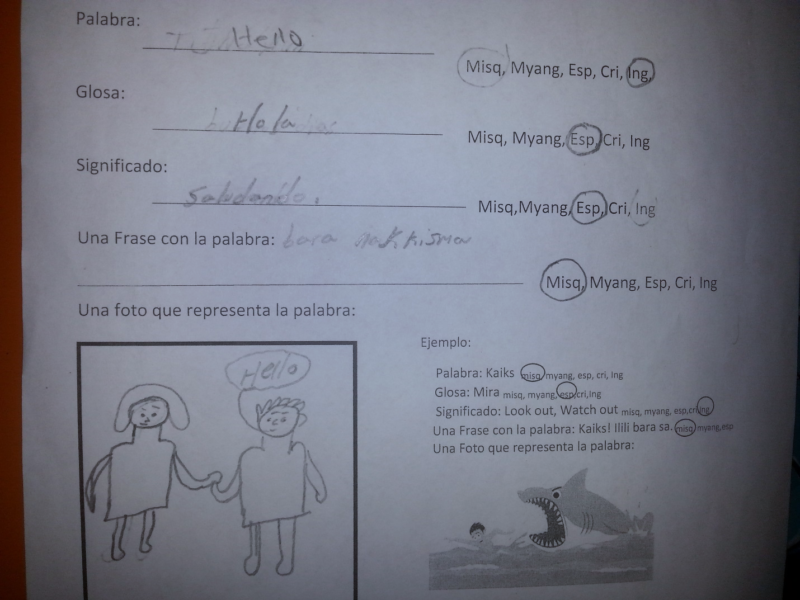
Ejemplo de una ficha de los diccionarios en ingles, español y miskito.

Example of a page from the dictionary in English, Spanish and Miskito.

This is the third article about the “Miskito and Mayangna on the Internet” project, grantee winner of the 2015 Microgrant call to support digital activism initiatives for indigenous languages. The project is being carried out in Nicaragua and seeks to strengthen local languages with the active participation of young people.

After the completion of the first stage of the project, the students in the Leadership School created comics with themes such as: “Living with AIDS”, “Racial Discrimination”, “Bullying,” “Caring for a patient”, “Luhpia Saura, Luhpia Pain ” and “Liwa Máirín“. These entries were written in three languages: Spanish, Mayangna and Miskito.

At the end of this phase of the project, the instructor had a meeting with Elizabeth McLean, the only Mayangna linguist from the URACCAN University, who explained that the Mayangna elders in Siuna and Bonanza–which are Mayangna communities in the North Caribbean Coast–did not agree with online publishing material written in the Mayangna language. Ms. McLean explained that any video, website or dictionary published in Mayangna could not be posted outside the Mayangna communities. Thus, the students were instructed to set any website in Mayangna language in offline mode. This situation created an opportunity for the students to discuss the views regarding the linguistic diversity among indigenous communities on the Caribbean coast of Nicaragua and in other countries.

After they were requested not to publish content in Mayangna language on the internet, some students of Miskito origin asked: “Why could we publish materials in Miskito language and not in Mayangna?”. They said that they wanted to share their language with the Mayangna students, but that this intention seemed not to be reciprocal. The instructor had to explain that this situation was not unique to that local context, but these are attitudes which sometimes arise in all kinds of scenarios. The instructor added that communities in many other regions have the same views and that indigenous communities have the right not to share their knowledge. Following these discussions, it was decided that the videos, websites and dictionaries in Miskito could be published without restrictions, while materials in Mayangna could not be disseminated on internet or in spaces outside the northern Caribbean communities.

After expressing a personal perspective on writing, the instructor planned a meeting with Ms. McLean to create files for the digital dictionaries in Spanish, Miskito and Mayangna. Both the instructor and Ms. McLean were interested in supporting the writing in the two indigenous languages, and this position was largely due to their linguistics training. They translated into local languages terms like “words, comments, meaning and phrase”. Later, the students filled the files with their first entries of digital dictionaries. In a later meeting, the instructor and Ms. McLean prepared a lesson to explain to the students some particular aspects of the language structure, such as differences between nouns in Miskito and Mayangna, focusing primarily on expression of possession and pluralization.

Three classes on creating the multilingual dictionaries were carried out. In the first session, a worksheet was used for the first entries, and many students chose to write greetings such as “naksa – hello” and “nakisma – how are you”. Before this, the participants were recommended to follow the dictionary structure that had been prepared, in regards to words, comments, meanings, examples of phrases, and even images. Once the students were able to understand how to configure the entries for the dictionary, they proceeded to generate a greater number of entries.

The students decided to create two trilingual dictionaries, in which, in addition to local indigenous languages, English and Spanish were also used. The strategy was to create word lists in Miskito and Mayangna, and then to translate them into Spanish and English. The interest to include the two major languages mainly comes from the fact that students have classes in English and Spanish at the university.


Read Full Story from Rising Voices https://rising.globalvoices.org/blog/2016/11/07/writing-a-lesson-about-views-on-language-in-the-mayangna-and-miskito-communities/
This article by originally appeared on Rising.globalvoicesonline.org on November 07, 2016 at 05:00PM

Monday, September 26, 2016

A Specially Designed Keyboard Allows Yorùbá and Igbo Speakers to Type Their Languages

Screenshot from "How Do You Tone Mark in Yorùbá?"

Screenshot from “How Do You Tone Mark in Yorùbá?”

Typing Nigerian languages, such as Yorùbá and Igbo, is usually a challenge as most keyboards are not equipped for the tonality that characterizes them. These technical barriers have been a source of concern for many Nigerians who would wish to type their local languages properly.

However, this might no longer be an issue thanks to YorubaName.com, which has developed a Yorùbá and Igbo keyboard. YorubaName.com is a multimedia dictionary of Yorùbá names, which seeks to:

…preserve and document all Yorùbá names in a multimedia format. It is part of a long-term project to document all types of African cultural experiences on the internet as a way of ensuring the survival of African identities in their various expressions.

YorubaName.com was founded by Kọlá Túbọsún, whose bachelor of arts’ thesis formed the backbone of the project. He and his team of linguists and techies, including Global Voices author and translator Laila Le Guen, are behind the keyboard.

Laila has been a volunteer with the YorubaName project since March 2015, and she recently completed a three-year diploma in Yorùbá studies offered at Inalco, Paris, that included a rigorous language course alongside specialised classes in linguistics, history, literature and anthropology. She explained in an interview the issue that the keyboard solves:

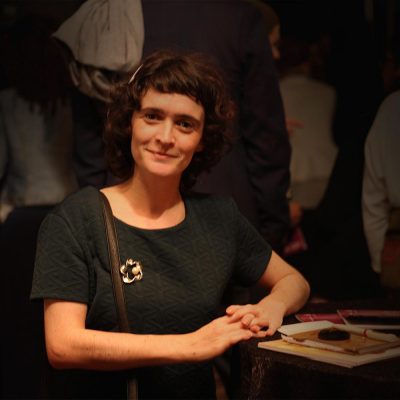
Laila Le Guen, Core Team member of YorubaNames.com, Editor and Translator

Laila Le Guen, YorubaNames.com team member, editor and translator.

With this keyboard, we are addressing technical barriers to the use of Yorùbá and Igbo online. The new keyboard is an updated version of a keyboard layout we released last year to fill a gap in technological solutions to type Yorùbá in standard orthography. Yorùbá makes use of grave accent, acute accent and occasionally macron (n̄) to mark tone, and some characters include subdots (ẹ ọ ṣ). Some keyboard layouts existed on Windows and I had created one for Mac for my personal use since none existed at the time but all these efforts were scattered and inconsistent. The idea behind the YorubaName keyboard layout was to propose a user-friendly package for Mac and Windows and also to take advantage of our existing platform to promote its use.

Yorùbá is both a language and the name of one of three major ethnic groups in Nigeria. Besides Nigeria, it is also spoken in the Republic of Benin and in communities elsewhere in the world. There are about 30 million speakers of Yorùbá worldwide. 

Nigeria hosts about 250 ethnic groups and 500 languages, but information and communication technology is generally not made with any of those languages in mind. There's also the issue of preserving and promoting their cultural and language identity while abroad: Although there is paucity of accurate statistics, rough estimates drawn from different Nigerian embassies and the International Organisation for Migration show that 15 million Nigerians live outside the country. This seems valid because according to reports, Nigerians living abroad remitted US$21 billion back home in 2014 alone.

Nigerians in the diaspora and those at home wish to keep their identity alive. They want to type, send and receive SMS and make social media posts in their local languages, but most times they are unable to do so. Thus the justifiable interest in the new keyboard developed by Leila and her colleagues.

Laila and Kola in Ibadan

Laila and Kola engaging some students in Irawo, a private hall of residence affiliated to the University of Ibadan, Nigeria during a road tour to promote YorubaNames.com in July. Image used with permission

As part of their research into the keyboard's development, Laila and Kọlá went on a road tour that took them to the cities of Ibadan and Lagos. Even though Yorùbá isn't only spoken in Nigeria, the keyboard is aimed at Nigerian Yorùbá speakers, Laila stressed:
It's important to note that, although Yorùbá is also spoken in neighbouring Benin Republic and marginally in Togo, we are using the Nigerian official orthography and targeting Nigerian and English-speaking diaspora users (for now). There are a couple of reasons for this: Benin Republic uses a different official orthography for Yorùbá but it is seldom used, as scholars and students import books from Nigeria and have become more familiar with the Nigerian standard – this issue is a bit controversial in academic circles in Benin Republic. Besides, very few speakers of Yorùbá in Benin are literate in the language, as it is not taught in school at all other than in specialised programmes for linguists and as part of (rare) adult literacy classes. Finally, keyboards in Benin Republic are made on the French model, but this would be easily solved by adapting the template. We aim to extend our audience to Beninois people very soon by translating the platform into French and hopefully serve their technological needs more adequately.

Although it originally focused on Yorùbá, the keyboard eventually expanded to Igbo, another major Nigerian language. Laila explained:

When we started sharing the keyboard layout on social media and encouraging our community to use it, we received a number of requests from Igbo speakers to make a similar product for their language. It turns out that Igbo orthography is very similar to Yorùbá, in the sense that it also includes grave and acute accents as tone marks, as well as subdots. Since Igbo requires only a couple of extra characters (ị, ụ and ñ), it made sense to add them in the updated June 2016 release.

The keyboard aids users to switch from English to Yorùbá and Igbo, and is adapted for both Mac and Windows operating systems. Laila gave a synopsis of the unique features of this keyboard:

The keyboard enables users to type English, Yorùbá and Igbo without switching language preference settings. The key combinations to type characters such as ṣ or á are easy to memorise which makes for a fast learning process. It's available for Mac and Windows and we're hoping to develop a Linux version and mobile solutions in the future. Also, it's free 🙂

In a country where ethnic narratives are often characterized by hate, a project that seeks to immortalize Nigerian native languages using online tools is more than heartwarming. This is especially instructive because languages are the purveyors of culture and all the other aspects of the identity of a people.


Read Full Story from Rising Voices https://rising.globalvoices.org/blog/2016/09/26/a-specially-designed-keyboard-allows-yoruba-and-igbo-speakers-to-type-their-languages/
This article by originally appeared on Rising.globalvoicesonline.org on September 26, 2016 at 07:06PM

From Making Videos to Digital Activism: Learning Experiences in the Mískitu and Mayangna Languages

Grabación de “La Vida con SIDA - SIDA Wal Iwanka” en Miskito.

Recording of “Life with AIDS – SIDA Wal Iwanka” in Miskitu.

This is the second article about the “Miskitus and Mayangnas on the Internet” project, grantee winner of the 2015 Microgrant call to support digital activism initiatives for indigenous languages. The project is being carried out in Nicaragua and seeks to strengthen local languages with the active participation of young people.

The project began with conducting a multimedia class in which young people in the Leadership School from the URACCAN University focused on taking smartphone pictures of their environment and create slideshows. During the class the students showed interest in how to integrate subtitles and narrations in the audio, opting to use the MovieMaker software for this purpose; many of the participants admitted to not being able to read and write in Mískitu [Miskito, in English] and Mayangna, while others who could, said they had never thought about adding text to their presentations. In addition to the incorporation of written elements, students were also interested in including popular songs in Mískitu, English Creole and Spanish, responding positively to the mixture of the media in different languages.

Throughout February and March, the students rarely had access to computer labs during their multimedia class. To solve this issue of limited access, their instructor added files to organize class activities in order to properly plan the designs using the computer software. Printed and digital guides were also created for students to design multimedia, such as an animated video, a website or a video game in Mískitu and Mayangna.

The students had a favorable response to the use of the files, which included a comics design with themes related to theater presentations that would later be recorded professionally. When students presented their comics, their instructor and school administrators were pleasantly surprised by the students’ ability to think deeply about issues related to social injustices such as: the lack of education about sexually transmitted diseases, bullying, the discrimination between races or ethnic groups, and poverty.

The students demonstrated their leadership skills in the development of the issues which reflected problems in the real world and in urgent need of innovative solutions. The products are intended for speakers of Mískitu and Mayangna living in Bilwi-Puerto Cabezas, the urban area surrounding the URACCAN University. Bilwi-Puerto Cabezas is a multilingual city that uses Mískitu, Mayangna, Spanish and English Creole languages, however, only the television news are bilingual in Spanish and Mískitu, so the themes developed by the students are the first productions in Bilwi-Puerto Cabezas which are using all four languages spoken in the city.

The students in the leadership school grew during this process as activists for their own languages to participate as designers of multilingual programs focused on promoting issues that affect the daily life in their communities. The young actors, directors, and producers enjoy their creations and hope the residents in their city and nearby communities can use these products to become activists, too, who promote changes in local social norms that allow the use of multiple languages in different contexts.


Read Full Story from Rising Voices https://rising.globalvoices.org/blog/2016/09/26/from-making-videos-to-digital-activism-learning-experiences-in-the-miskitu-and-mayangna-languages/
This article by originally appeared on Rising.globalvoicesonline.org on September 26, 2016 at 04:58PM

Tuesday, September 20, 2016

Ha'e Kuera Ñande Kuera: Reggae and Hip-Hop Expanding the Guarani Culture by Dialoguing With the World

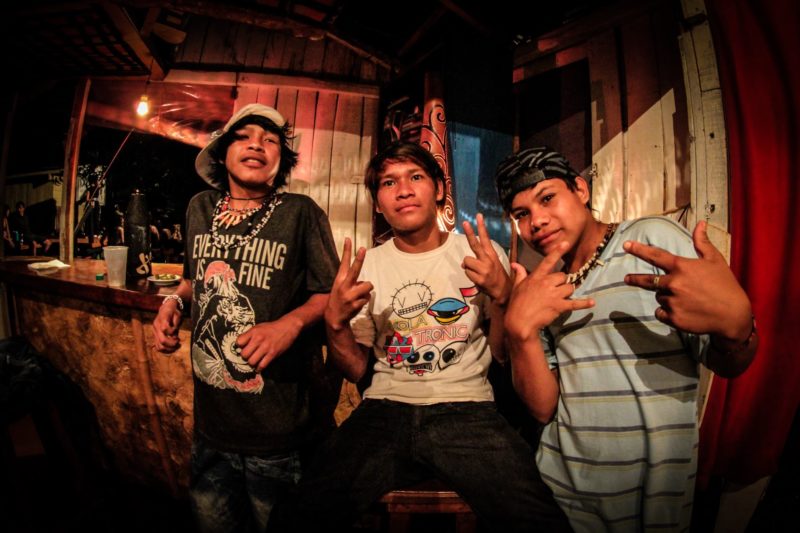
The group Ha'e Kuera Ñande Kuera. Photo shared by the musicians on their public Facebook page.

Fortín Mbororé is found in the region of los Saltos and Cascadas in the Misiones Province of northeastern Argentina. The village was created in 1985 and has a population of about 1,126 people who identify themselves as the Mbya Guarani people. It was within this community, which shares borders with Brazil and Paraguay, where a group of young people fused their concerns and demands with hip-hop and reggae sung in Guarani as well as Spanish and Portuguese.

This group is a trio called Ha'e Kuera Ñande Kuera, which in Spanish means “ustedes y nosotros,” or “you and us.” Its members are Juan Chamorro, Fabián Velázquez and Hilario Benítez, accompanied by a band of musicians bound together by this project.

The trio started in 2013, and in them converged three languages and two cultures. The group also mix traditional instruments with the saxophone, bass, drum, and electric guitar. The youths felt attracted to hip-hop and reggae because of its high protest content and hopes for social justice. This is how the Misiones Online reviews them in a note about Ha'e Kuera Ñande Kuera's participation in the 13th Conference of the National Network of Alternative Media:

El grupo cobra popularidad debido a que sus canciones transmiten la tristeza que sienten al ver que su cultura se pierde, que cada vez se quedan con menos tierras, y que siempre les cuesta conseguir sustento en la naturaleza.

The group gained popularity due to their songs, which convey the sadness they feel at seeing their culture being lost, ending up with increasingly less land, and always struggling to produce sustenance from nature.

Ha'e Kuera Ñande Kuera in context

Image published on Ha'e Kuera Ñande Kuera's official Facebook page.

In the last decade, mass media has reported the problems that afflict the Mbya community of Misiones. The headlines are alarming. Malnutrition and respiratory problems appear to be the most common ailments for Guarani children and youth. The community is faced with problems of malnutrition, of infant mortality, of exclusion and poverty and what's more, the threat of their own ethnic group's silent extinction.

Added to this is the penetration and intervention of lands in ways that threaten the community and cause forced displacements to the cities.

Ha'e Kuera Ñande Kuera's lyrics feed on the reality in which its members live. In this context, reggae and hip-hop, global music genres, open up a channel of communication that allows them to go further than the Guarani cultural boundaries and to reach the Creole population with a message of protest and awareness. At the same time, the use of the Guarani language in their songs awakens the interest of Mbyan youths, who find a voice by which to express their local maladies.

Social networks, indigenous identity, and global culture

Ha'e Kuera Ñande Kuera's official Facebook page has allowed interaction between the musicians, their followers, and those interested in the group. With it they have generated discussions about the appropriation of global cultural products by other indigenous groups. There is no shortage of opinions that support the belief that the natives should be kept in a Utopian state of purity and isolation in order to be considered that way by the rest of society. The young people who make up Ha'e Kuera Ñande Kuera, however, have a very clear opinion about their own identity and the ways in which diversity and contact with other cultures enrich them.

On the other hand, groups like Ha'e Kuera Ñande Kuera are an example of multiple identities: for the Guarani community, the group's music and image belong to the Creole culture. For the audience foreign to the Mbyan context, the idea of Ha'e Kuera Ñande Kuera can be something mainly indigenous.

In short, the group represents the cultural consequence of various processes that contrast and interact within the musical genres that have influenced them up to now. As such, the music presents itself as a negotiation space in which urgent matters escape from the shadows and youths create a global community with cultural influences that, far from weakening them, strengthen them.

Hae Kuera Ñande Kuera – Nda ja rekovei opy arandu from lrtvcooperativa on Vimeo.


Read Full Story from Rising Voices https://rising.globalvoices.org/blog/2016/09/20/hae-kuera-nande-kuera-reggae-and-hip-hop-expanding-the-guarani-culture-by-dialoguing-with-the-world/
This article by originally appeared on Rising.globalvoicesonline.org on September 20, 2016 at 04:53PM

Tuesday, September 13, 2016

Meet the Newly Born Tulu Wikipedia, the 23rd in a South Asian Language!

Tigalari script. Image from Wikimedia Commons by ಶ್ರೀ. CC BY-SA 3.0

Tigalari script. Image from Wikimedia Commons by ಶ್ರೀ. CC BY-SA 3.0

The Tulu language Wikipedia became the latest entrant in the family of 294 world-language Wikipedia projects after the project went live from Wikimedia Incubator earlier this month.

The project waited as long as eight years in the Incubator before becoming the 23rd South Asian language Wikipedia. Available at https://tcy.wikipedia.org, the Tulu Wiki space has a total of 1,285 articles contributed by 198 editors, about 5-10 of which are active with over five edits every month.

The announcement about the project going live was made by Katherine Maher, Executive Director of Wikimedia Foundation during the WikiConference India.

Wikimedia Incubator is a sister project of Wikipedia and before any new language Wikipedia is created, an Incubator project is created and grown by volunteer editors. Once the project gains momentum with more editors developing more content more often, the project goes live as a new Wikipedia project.

The Tulu language is spoken by about three to five million people in the Indian states of Karnataka and Kerala, and there is a sizeable diaspora living in US and the Gulf countries.

Eight years back in 2008, Tulu Wikipedia was created in Incubator with just a handful of editors. But apart from a few sporadic edits every so often, there was little impetus to take the project forward.

A community in a real sense is one that engages in discussion, consensus and collaboration. This never existed for Tulu Wikipedia as individual editors were working in isolation from each other.

There was therefore a need for them to meet and form a strategic plan to grow the community and the Incubator by brining in more active contributors.

In 2014, the need to connect the Tulu Wikipedia editors and foster an interactive editorial group was discussed and a meetup was organized in Mangalore by the Centre for Internet and Society—Access to Knowledge (CIS-A2K) program, a catalytic program funded by the Wikimedia Foundation to support and grow Indian language Wikipedias and Wikimedia projects in the Indian subcontinent.

As an offshoot of that meeting, more community meetups started to happen. A few workshops were organized in Mangalore to provide hands-on training to participants and the city's St. Aloysius College opened its door to include Wikipedia editing as part of its syllabus.

A Wikipedia Education Program was promptly organized for the undergraduate students in this college where students started editing Wikipedia as a classroom assignment and the faculty was involved both in providing training and evaluating the articles.

Vishwanatha Badikana, assistant professor of the Kannada language department at St. Aloysius College, became an active Tulu Wikipedia editor himself and led outreach activities at the institution. His students have enriched the Tulu Wikipedia with articles across a broad range of topics.

The main page of Tulu Wikipedia. Image via Wikimedia Commons

The main page of Tulu Wikipedia. Image via Wikimedia Commons

However, what has been achieved so far is still only the tip of the iceberg. The community is still fairly small and has to grow beyond one supporting institution. The larger Tulu language community also has to take ownership and become stewards in growing Tulu Wikipedia.

Despite its long, rich linguistic heritage, Tulu is still struggling in terms of achieving wider usage in written form, especially in its native script. The lack of promotion is also quite evident as the Karnataka Tulu Sahitya Academy, an official body set up by the Karnataka government uses Kannada and English for its official portal.

The biggest challenge of all is the lack of Unicode support. Unicode is a global standard for scripts, and the Tigalari script that is used to write in Tulu is not encoded in Unicode. At the moment, all the articles in the Tulu Wikipedia are written in the Kannada script as most of the speakers are based in the state of Karnataka, and speak Kannada as a second language.

The only possibility of using Tigaliri script is tied to standardizing the script on Unicode, releasing a freely licensed typeface so that it can be bundled as a web font to display the script in the case of any mobile or desktop user not having the font installed on their device.Finally the script for existing content must be converted from Kannada to Tigaliri.

There is a series of eight how-to video tutorials that have been created to help new and existing editors to learn more about Wikipedia policies and guidelines, style and the editing process.

“Many students have contributed by creating these tutorials,” says Dr. Badikana.

The current set of editors are doing their best to spread the word about the project while safeguarding the core values of Wikipedia.

In an interview to the media portal Daijiworld, Bharathesha Alasandemajalu, an active editor based in Oman said, “Anyone can write or edit articles on Wikipedia Tulu, but it should not be plagiarised [..] Photos should be one's own or uploaded with valid permission from the owner. This will help the future generation to know more about the language and act as a source of information on Tulu language and culture.”

Dr. Badikana moreover shared in an interview with this author that he is hopeful of seeing more Tulu speakers contributing to Tulu Wikipedia, as he feels that growing language content online, combined with work in conventional classrooms, is the best approach to preserving the language.

Subhashish Panigrahi is a programme officer at the Centre for Internet and Society's Access to Knowledge program (CIS-A2K). CIS-A2K worked closely with the Tulu Wikipedia community to bring this project live.


Read Full Story from Rising Voices https://rising.globalvoices.org/blog/2016/09/13/meet-the-newly-born-tulu-wikipedia-the-23rd-in-a-south-asian-language/
This article by originally appeared on Rising.globalvoicesonline.org on September 13, 2016 at 11:58PM

Wednesday, August 10, 2016

So Long, Phone Companies. Mexico’s Indigenous Groups Are Getting Their Own Telecoms.

Telefono-usuario

Rhizomatica members demonstrate how to operate a communal cell phone. Image from Rhizomatica Wiki under Creative Commons license.

Members of the Mixe, Mixteco, and Zapoteco people will soon have their own mobile cellular telephone network that will allow at least 356 municipalities in the States of Chiapas, Guerrero, Oaxaca, Puebla, and Veracruz, to access mobile-telephone services and the Internet.

The new services are the result of a July 5 plenary resolution by the Instituto Federal de Telecomunicaciones, or IFT (Federal Institute of Telecommunications), that granted for the first time in Mexico's history two licenses to operate a telecommunications network for social indigenous use to the nonprofit organization Telecomunicaciones Indígenas Comunitarias A.C. (TIC A.C.) (the Indigenous Community Telecommunications).

On that topic, the Federal Institute of Telecommunications stated:

Con estas concesiones se habilitará a su titular [TIC A.C.] a prestar servicios de telecomunicaciones para la promoción, desarrollo y preservación de sus lenguas, su cultura, sus conocimientos, promoviendo sus tradiciones, normas internas y bajo principios que respeten la igualdad de género, permitan la integración de mujeres indígenas en la participación de los objetivos para los cuales fue solicitadas las concesiones y demás elementos que constituyen las culturas e identidades indígenas.

These two licenses will enable Indigenous Community Telecommunications to provide telecommunications services for the promotion, development, and preservation of their languages, culture, and knowledge, promoting their traditions and norms based on principles that respect gender equality and allow the integration of indigenous women into the participation of the objectives for which the licenses were requested along with other elements that make up the indigenous cultural identities.

According to Redes por la Diversidad, Equidad y Sustentabilidad, A.C. (Networks for Diversity, Equality, and Sustainability Nonprofit Organization), the network Telefonía Celular Comunitaria, (Communal Cell Phone) (which has been acquired, managed, and operated since 2013 by the Villa Talea de Castro community in the northern mountain range of Oaxaca) is directly responsible for this effort to provide connectivity to indigenous communities at affordable costs.

Talea de Castro

Photo taken in Villa Talea de Castro, courtesy of Daniela Parra and used with permission, REDES AC.

As Global Voices previously explained, prior to 2013, the 2,500 inhabitants of Villa Talea de Castro relied on high-cost landline phone booths. After the large cell phone companies repeatedly refused to provide them with service, the community got together and—with the technical and legal assistance of the NGO Rhizomatica—it managed to install its own local cellular network, providing the community with “unlimited local calls and messages, long distance and international calls at a cost of up to 98 percent less than [that] offered by other telephone service providers.”

Once the cellular network went into operation, the local radio station (“Dizha Kieru,” or “Nuestra Voz” in Zapotec language) together with Rhizomatica started to explore new ways to promote citizen journalism and community communication. This project was supported with a small scholarship from Rising Voices in 2013, in accordance with the announcement of the winners for that year:

La estación de radio, junto con la organización Rhizomatica, formará a los residentes locales para convertirlos en recolectores de noticias comunitarias a través del reportaje en persona o a través de mensajería de texto o llamadas de los ciudadanos. El equipo de Dizha Kieru, que administra tanto la radio como la estación GSM reunirá, sintetizará, editará y enviará los reportes noticiosos a los residentes dos veces al día a través de mensajes de texto masivos […]

The radio station, together with the organization Rhizomatica, will train local residents to become community news gatherers through in-person reporting or through collection via SMS or phone calls from citizens. The Dizha Kieru team, who run both the radio and GSM base-station will collect, synthesize, format, and send out the news reports to residents twice a day via mass SMS […]

This first local cellular network functioned as a pilot project that was then replicated in other communities. The following video recounts the initial stages of this project:

According to the statement issued by Networks for Diversity, Equality, and Sustainability, the 16 rural and indigenous communities that up until that time formed part of the community telephone network, formed a co-op with Rhizomatica and created the Telecomunicaciones Indígenas Comunitarias, A.C. (Indigenous Community Telecommunications nonprofit organization), in order to take the next step toward getting the licenses from the IFT and operating a telecommunications network for social indigenous use, which was recently authorized.

Rhizomatica marked the authorization with a celebratory tweet:

Erick Huerta, a TIC A.C. consultant and member of the IFT Advisory Council, recognized the long battle that the towns and indigenous communities have had to fight in order to acquire, manage, and operate their own network:

Este hecho histórico es sólo un pequeño paso de un sueño que empezó a realizarse hace muchos años y que se construye día a día en las comunidades indígenas de nuestro país quienes, bajo sus propios principios, generan formas de atender sus necesidades con sus recursos, en esquemas de colaboración y apoyo mutuo, invirtiendo la lógica de dependencia por la de autonomía.

This historic act is just one small step towards a dream that started to take place many years ago and that is created one day at a time in the indigenous communities of our country who, from their own principles, generate ways to attend to their needs with their resources, in collaborative frameworks and mutual support, exchanging the logic of dependence with autonomy.

This is how the Indigenous Community Telecommunications network came to be the new telecommunications service provider managed both by and for the indigenous communities. With that it is hoped that instead of seeking economic profit the objective will be to serve the people, encouraging Internet access for the communities, supporting their dynamics, processes, and full exercise of their rights. A network that, without a doubt, goes beyond technology.

For more information, visit the Networks for Diversity, Equality, and Sustainability website to read about community cellular networks and the Rhizomatica Wikipedia page.


Read Full Story from Rising Voices https://rising.globalvoices.org/blog/2016/08/10/so-long-phone-companies-mexicos-indigenous-groups-are-getting-their-own-telecoms/
This article by originally appeared on Rising.globalvoicesonline.org on August 10, 2016 at 07:11PM

Wednesday, July 27, 2016

‘Talking Dictionary’ Transmits Language of Japan's Indigenous Ainu People

Ainu

Ainu singers at the Ainu Museum in Hokkaido, Japan. Screencap from Andrew Jones Productions YouTube channel.

An online “talking dictionary” first launched in 2009 is attempting to preserve and pass on the Ainu language spoken by the indigenous inhabitants of Japan's northeastern island of Hokkaido and Russian island territories to the north. According to UNESCO, there are eight languages in Japan that are critically endangered, and the Ainu language tops the list with the highest degree of endangerment.

The project involves collaboration between Ainu speakers, the Endangered Languages Documentation Programme (ELDP) of School of Oriental and African Studies (SOAS), the Arcadia Trust, and Anna Bugaeva, a linguistics researcher at the Waseda Institute for Advanced Study (WIAS) in Japan. The purpose of the online project, completed in 2009, is not only to help preserve and transmit the Ainu language, but also to provide a safe long-term repository of language materials, to enable people to see what documentation has been created for a language, to encourage international co-operation between researchers, and to provide advice and collaboration for similar projects with other endangered languages around the world.

The Ainu Talking Dictionary preserves and presents conversational Ainu in an online, searchable format. There is also an interface for linguists, and detailed notes about how to use the online resource.

There is an urgent need to preserve the Ainu language. Although numbers are difficult to determine — questions about ethnicity are not included in the Japanese Census — it's estimated that just 25,000 Ainu remain in Japan, with fewer than 10 native speakers of the Ainu language. The Ainu people are the indigenous inhabitants of Hokkaido in northeastern Japan, as well as a string of islands to the north of Japan in Russia's Far East. When Japan decided to colonize Hokkaido and Sakhalin in the 1850's the Ainu were assimilated, placed on reservations, and succumbed to newly introduced diseases.

Today, Ainu culture in Japan mainly lives on at tourist attractions and in folk museums in Hokkaido and Tokyo.

Students try out the mukkuri, a traditional Ainu instrument. “That's a cool name for an instrument!” Students experienced dances, storytelling, and other cultural traditions. ― Asahi Digital.

In the 20th Century Ainu elder and politician Shigeru Kayano, who died in 2006, helped popularize Ainu language culture in Japan in well-known books such as ‘Our Land Was A Forest.’ Kayano also produced a simple Ainu phrasebook that is still in print.

[…] Here's the first volume of the Ainu Conversational Dictionary by Shigeru Kayano. I used to be really into Ainu culture and bought this book. Although I hate Street Fighter-type video games, I did learn the names of the Ainu characters in the Samurai Shodown games by SNK.

The Ainu Talking Dictionary goes beyond Kayano's series of Ainu-Japanese print dictionaries. The talking dictionary is part of research project “Documentation of the Saru Dialect of Ainu” by Anna Bugaeva, a PhD Assistant Professor of Linguistics at the Waseda Institute for Advanced Study (WIAS), Waseda University in Tokyo, Japan.

The project is based on a dictionary compiled by by Kotora Jinbo and Shouzaburo Kanazawa, first published in 1898. Jinbo, a surveyor, had learned Ainu to communicate with indigenous people living Hokkaido. Kanazawa, a linguist, documented words and phrases to create the dictionary that would help transmit the Ainu language into the 21st Century.

According to Bugaeva:

The original dictionary by Kotora Jinbo and Shozaburo Kanazawa contained mistakes, misheard words, and even broken phrases (expressions that are inconceivable with original Ainu grammar). We deleted all questionable words and examples, items that were extremely different from Setsu Kurokawa’s audio, and words that Setsu Kurokawa was unfamiliar with. Double entries were basically consolidated to one entry. However, since the video data and audio data were recorded separately, there are cases where the Ainu expression is different in the video and audio. In those cases only, we decided that these were separate expressions, and listed both. In the end, we had 3467 headwords. For particularly rare words, we checked whether they were used in existing dictionaries, and added notes to them.

[…]

In addition to the original notations, various information that can aid learning the Ainu language including the colloquial translation, Modernized Roman character transcriptions and katakana [a Japanese phonetic syllabary] transcriptions of the Ainu word, interpretation (glossary) and English translation, etc., are provided. With the help of Setsu Kurokawa, a native speaker of the Saru Dialect of Ainu (Nukibetsu), we were able to upload audio of the Ainu language onto the web. We received many responses and comments from students and researchers regarding these contents. However, we were faced with budgetary restrictions when building the dictionary, and some technical problems remained.

Bugaeva worked with Setsu Kurokawa to record the pronunciation of words and phrases used in the Ainu talking dictionary. Kurokawa, an Ainu elder born in 1926 in Nukibetsu, in southwestern Hokkaido, grew up hearing the language:

When Setsu Kurokawa (born, January 5, 1926) was a child, in the late 1920's, many Ainu families had already stopped speaking Ainu at home. Considering this, Setsu Kurokawa's proficiency in Ainu is relatively high. This can be explained by the fact that she was often taken care of by her grandfather and grandmother. However, since Ainu is not used currently in everyday life, it was difficult to record the spontaneous utterances of the language. In this audio material, the words and expressions are not the spontaneous utterances of Setsu Kurokawa, but instead are audio data initiated based on the Ainugo kaiwa jiten [Ainu conversational dictionary]. In the actual recording process, Anna Bugaeva read the words and expressions in the Ainugo kaiwa jiten, and Setsu Kurokawa repeated these in her own manner. The Ainu language expressions in this audio material are based on the Ainugo kaiwa jiten, and do not completely match Setsu Kurokawa's idiolect.

Bugaeva's finished dictionary was presented to a group of Ainu community members in Tokyo at the Ainu Cultural Center (which itself has online resources dedicated to transmitting the Ainu language) in February 2009. The online tool created in collaboration with Japanese co-editor Shiho Endo and programmer David Nathan (ELAR director, SOAS, University of London) and with an art input of the Ainu community, with web-design by Tamami Kaizawa.


Read Full Story from Rising Voices https://rising.globalvoices.org/blog/2016/07/27/talking-dictionary-transmits-language-of-japans-indigenous-ainu-people/
This article by originally appeared on Rising.globalvoicesonline.org on July 27, 2016 at 11:46PM

Tuesday, July 26, 2016

‘HiviSasa’, a Kenyan Citizen Media Project for Mobile Web

The logo of HiviSasa.

The logo of HiviSasa.

HiviSasa, Swahili for “right now”, is a Kenyan digital media project publishing news and photos from citizen reporters who are paid via M-Pesa, a mobile payment system, for every article published. Some citizen reporters, according to the site, earn up to about US $85 per week.

The project also awards writers whose articles attract the highest number of pageviews with cash prize every week.

The website currently covers 10 counties in the country: Nakuru, Kiambu, Machakos, Kisii, Nyamira, Kisumu, Uasin Gishu, Garissa, Mombasa and Kibera.

HiviSasa

HiviSasa as seen on a mobile phone. Creative Commons image by Jakobbarnwell.

HiviSasa explains its ethos on its website:

Accessible, diverse, transparent information empowers both governments and citizens. Better informed citizens make better decisions about their lives and their government.

Registration to be a contributor for the site takes less than a minute and one does not need to be a trained journalist to write for HiviSasa:

You can be a professional, an organisation, a student, a government officer, a politician, a concerned citizen, a cartoonist, a businessman, a bystander… etc. Also, many trained journalists also contribute, which increases their skills and online exposure.

Write a 200-words news story (or submit a new photo with a short description) answering the questions: What event? Where and when did it happen? Who was involved? How did the event occur? Why is it noteworthy?

The site has identified three examples of good local stories for new writers. One of the stories is about a Kenyan man, Lawrence Gekonge, who buried his wife in the kitchen after she passed away because she used to spend most of her time there.The man says that he should be buried in the sitting room of the main house when he dies.

The second story is about citizen reporter, Dickens Luvanda, who has managed to consistently publish over 50 stories a week. The third one is about 1,200 title deeds lying uncollected at the Lands Registry.

The project's lead editor Enoch Nyariki told Global Voices in an email conversation that the site has so far published 61,000 stories. He said that one of the main challenges the project is facing is having citizen reporters take advantage of free HiviSasa Academy they have set up to empower reporters with basic news writing skills.

The YouTube video below is an introduction to the academy in Sheng, a mixture of Swahili and English:

The academy offers various free lessons such as How To Interview, How to Report Court Stories, Writing Lawfully – Plagiarism/Accreditation, Writing Lawfully – Defamation/Libel, Hate Speech, etc.

Piloted in 2012 with the support of 88mph, which invests in start-ups, the project was launched in January 2014. Other investors in the project are Omidyar Network and Novastar Ventures.

Editor's note: Global Voices also receives support from Omidyar Network.


Read Full Story from Rising Voices https://rising.globalvoices.org/blog/2016/07/26/hivisasa-a-kenyan-citizen-media-project-for-mobile-web/
This article by originally appeared on Rising.globalvoicesonline.org on July 27, 2016 at 01:16AM

Monday, July 25, 2016

One Children's Song, Translated Into Australia's Many Local Languages

Languages and cultures may differ, but the joyful sound of children singing is universal. A song called “Marrin Gamu,” created for primary school children and teachers to promote the diversity and beauty of Australia's Aboriginal and Torres Strait Islander languages, is proving just that.

The title of the song combines the word for “body” in two of the languages. Marrin is the word for “body” in the Wiradjuri language of New South Wales, and Gamu is the word for “body” in the Kalaw Kawaw Ya language from the Torres Strait.

The song is also the basis of a friendly contest organized by First Languages Australia and ABC Splash. First, communities are invited to teach local children the lyrics in English.

Verse 1. Eyes and ears, (3 times).
Verse 2. Hand and foot, (3 times).
Verse 3. Leg and arm, (3 times).
Verse 4. Head and belly, (3 times).

Then once the children know the song, the community is asked to translate the lyrics into their own native language. Finally, the community and school work together to create a video to be uploaded to the competition website.

The Marrin Gamu website provides an example to help get teachers and students started. Also included in the website is a range of Australian curriculum-linked classroom activities developed around the project. Conversation starter questions are suggested as a way to facilitate discussions with students about their language:

Questions for the class:

  • Are their any similarities between the body words in the languages in the video and your language?
  • Is there any reason the song cannot be directly translated into your language?
  • What might you do to overcome this?

The project will run for the next two years so that all schools have time to develop the necessary relationships to participate in the project. Contest organizers hope to see “Marrin Gamu” sung in many of Australia’s hundreds of first languages.

“Marrin Gamu” fits into a broader strategy to prevent language loss by focusing on schools and students and working with local teachers. Many teachers do not have deep knowledge of these languages, so the website shares cross-curricular programs for use in the classroom. Incorporating an element of digital media and the internet may motivate students when they see their creativity and local language reflected online.

Screenshot from Guarang language video.

Screenshot from Guarang language video.

The first submission is a video created by a school in Queensland in which students sing “Marrin Gamu” in the Guarang language. As more videos of the song are submitted, we'll be sharing them here.

Read Full Story from Rising Voices https://rising.globalvoices.org/blog/2016/07/25/one-childrens-song-translated-into-australias-many-local-languages/
This article by originally appeared on Rising.globalvoicesonline.org on July 26, 2016 at 01:40AM

Thursday, June 23, 2016

Tuesday, June 14, 2016

A Grandmother and Granddaughter in India Are Making Beautiful Media Together

Miss Pickles 2010. Image via indrimspickles.com

Miss Pickles 2010. Image via indrimspickles.com

An older woman in a lab coat looks into the camera. Her name is Dr. Indri Pickle, and she explains to viewers that she will show them how to make mango pickles, which are very popular in South Asian countries. She proceeds to draw the basic formula on her Pickle Lab's chalkboard: sunshine + mango.

Dr. Indri Pickle is actually 84-year-old Inderjit Kaur, who goes by Indri, and she's not really a mango pickle scientist. In the video which was recently uploaded to YouTube, she's acting. It's with the help of social media tools like YouTube, blogs, Twitter and Facebook — as well as her granddaughter Jasmeen Patheja — that Indri is fulfilling her dreams of becoming an actor.

Jasmeen, who is an artist, feminist and the founder of the public and community arts collective Blank Noise, which confronts street harassment of women, wanted to learn photography and video. Her grandmother, wanting to become an actor, became a willing artist, and collaborator. Together, they've produced a series of photo performances based on characters of Indri's choosing, in addition to the Pickle Lab video.

Indri also shares her life story on her blog.  In the post, she mentions that she was born and brought up in Burma and remembers the Japanese attacks during the Second World War when she was a young child. She recounts the long travel her family took to move to India (Lahore) in 1941. She moved back to Mogok, Burma after World War II. Indri was married at the age of 19 and lived in Burma until 1970.

Global Voices spoke to Indri and Jasmeen to learn more about their work.

Global Voices (GV): Did you teach your grandmother how to use social media? What are the challenges she faced?

Jasmeen Patheja: I did not teach her how to use social media, but I have been there to introduce or pitch in with explaining concepts, behaviours and types of web engagement. I love that she often uses YouTube for ‘traveling’, she visits Japanese zen gardens through YouTube, or uses YouTube for education through bonsai tutorials. She also uses YouTube to listen to her morning hymns. A lot of this has been through years of stumbling upon and discovering new spaces on the web, including YouTube, Facebook, Twitter. I step in when she has questions about the different kinds of spaces, e.g. “What is the difference between Instagram and Twitter and Facebook and Tumblr?”, there are different formats, each lending to different kinds of behaviour. Indri uses Facebook, Google, YouTube, WhatsApp with most ease. Very early on, Indri learnt to use paint, Microsoft Word, play cards (solitaire), send e-greetings.

Indri lives alone and is independent. She loves that the internet allows her to use web portals for buying grocery and products (Flipkart/Bigbasket). At this point she really wants to learn to book a ticket to travel!

I asked Indri about what she finds most challenging, and Indri spoke about language and vocabulary.

Inderjit Kaur: The whole world is learning, why should I not learn? I have a lot more to learn. It is important to walk along with the world.

Indri Acting

Indri acting in a photo performance. Image via indrimspickles.com

GV: What prompted you to come up with this idea and go forward with this initiative?

Jasmeen Patheja: I wanted to take photos. My grandmother wanted to act. My grandmother Indri and I have been collaborating for years.

I was also in art school and pursuing photography/community arts. Indri’s desire to act has been the start of this collaboration. This premise led to mutual exchange. It created a series of photo performances based on characters Indri desires to become. This collaboration emerges from play, curiosity, desire. Performances range from queen, politician, scientist.

We collaborate because we enjoy the process. We both think we “get lost in acting and photo making”, it nurtures both of us. It makes us happy.

Indri Pickle Lab came out of the larger series of photo performances, and here Indri plays a scientist making mango pickle in her laboratory. The idea was spontaneous, but also looking at pickle making, precision, science, labour and knowledge sharing.

Jasmeen Patheja with her Grandma Indrajit Kaur.

Jasmeen Patheja with her grandmother Indrajit Kaur. Image via indrimspickles.com

GV: What response did you get from readers?

Jasmeen Patheja: A very endearing response and a very encouraging one too. Indri and I have made new friends through this collaboration. Women (family friends and extended relatives) Indri’s age have responded with surprise, encouragement, often expressing desire to team up with their granddaughters too.

We also went on a residency together at [German art-in-residence program] Akademie Schloss Solitude in 2010, an institute that has supported this collaboration very early on.

Readers have responded with love and encouragement and we are so glad that something we have created is receiving love.

Indri posing

Indri posing. Image via indrimspickles.com

GV: Many members of our generation are losing touch with their older relatives as families become more fragmented and people live farther apart. How can social media and web tool help bridge the gap?

Jasmeen Patheja: My family is spread across cities and countries. I live in Bangalore. My grandmother lives in Calcutta. At this point my grandmother hasn’t seen her grandsons in two years, nor has she seen her five-month-old great grand daughter. Her desire to connect leads to using the web. Yes, the the gap can be bridged through the internet.


Read Full Story from Rising Voices https://rising.globalvoices.org/blog/2016/06/14/a-grandmother-and-granddaughter-in-india-are-making-beautiful-media-together/
This article by originally appeared on Rising.globalvoicesonline.org on June 14, 2016 at 04:55PM

Latest Posts